Blog
Insights on email-native learning, productivity, and skill development
Code Interviews Test Recall — Employers Want Judgment
Code Interviews Test Recall — Employers Want Judgment
Published: November 9, 2026
Tags: Interviews, Hiring, Software Engineering, Career, Certification
The Exam You've Been Cramming for Isn't the Exam They're Running
You know the ritual. Six weeks before the interview loop, you dust off the algorithms book, grind practice problems, and drill Big-O until you can recite complexity classes in your sleep. Then you walk into the room — or the shared document — and a stranger watches you reverse a linked list on a whiteboard while your heart pounds at a heart rate most people only see on a treadmill.
Here's the strange part: the person on the other side of that whiteboard probably doesn't believe in the exercise either. Ask hiring managers what they actually want, and the answer is remarkably consistent across surveys and post-mortems: judgment. They want someone who can look at a messy production system, weigh three bad options, pick the least-bad one, and explain the trade-off without flinching. They want system thinking, risk calibration, the ability to say "this is good enough, ship it." None of that is what the live-coding gauntlet measures.
What it measures is recall under observation — a narrow, noisy, and frankly weird signal that the industry adopted because it was easy to administer, not because it predicted anything.
Watching Someone Code Halves Their Performance
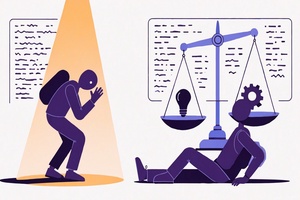
This isn't just interview folklore — there's a measurable effect. In a widely cited line of research out of NC State, Mahdi Behroozi and colleagues put experienced engineers through technical tasks and found that being observed while problem-solving roughly halved measured performance compared with working privately. The stress of performing in front of an evaluator doesn't just feel bad — it actively suppresses the cognitive capacity you're being scored on. Add the well-documented bias effects (the format systematically filters out candidates who weren't drilled in it, regardless of ability), and the whiteboard interview starts to look less like a selection tool and more like a stress test that happens to involve code.
And it gets worse on the predictive side. The classic Schmidt & Hunter meta-analysis — still the reference point in personnel-selection research — ranked every common hiring instrument by how well it predicts actual job performance. Work-sample tests and structured interviews sit near the top. Unstructured conversational interviews and credential-gazing sit near the bottom. The live-coding puzzle interview, as usually practiced, behaves like the worst of both worlds: an unstructured conversation wearing a work-sample costume.
So you have a process that measures something employers don't primarily want, under conditions that degrade the thing it does measure, producing a signal that predicts weakly. And it remains the industry's front door.
The Two Signals, Separated
Strip the confusion away and there are really two distinct capabilities being conflated:
- Recall — can you produce the right syntax, the right pattern, the right complexity bound, right now, from memory, with someone watching? It's real. It matters. But it decays fast, varies wildly with stress and sleep, and says little about how you work on a Tuesday afternoon when nobody's grading you.
- Judgment — given incomplete information and real constraints, do you make defensible calls? Do you know when a mutex is wrong and a channel is right, when to denormalise, when the elegant abstraction is a trap? This is what employers describe when they say they want a "strong engineer" — and it's nearly impossible to observe in a 45-minute whiteboard session.
The interview industry's dirty secret is that judgment questions — "walk me through a system you'd design," "tell me about a trade-off you regret" — are graded on storytelling. The candidate who rehearses the best narrative wins, whether or not their underlying technical foundation is solid. Recall questions grade memory under pressure. Neither reliably verifies the floor: does this person actually have command of the language and tools they claim?
That gap is your opportunity. You can't reform the interview loop. But you can walk into it having already answered the question the loop answers badly.
Close the Proof Gap Before They Open It
Here's the move most candidates never make: separate the two signals deliberately, and get the recall half verified on your own terms — calm, unobserved, against a fixed standard — so the interview can be about judgment.
Think about what changes. Without evidence, you walk in hoping the whiteboard goes your way, and every recall question is a referendum on your worth. With a verified score already in hand, the dynamic shifts: the fundamentals are established, and you're free to spend your preparation where the real hiring decision happens — architecture discussions, trade-off reasoning, the "tell me about a time" questions that actually differentiate seniors from juniors. You stop treating every question as existential, because the existential part is already proven.
This is exactly what a rigorous, self-paced assessment buys you. ProvedExpert's Golang 1.27 Professional exam, for example, is 30 questions over 60 minutes covering the breadth a working Go engineer is expected to command — concurrency, generics, the standard library, the toolchain through the latest release. Take it privately. Nobody's watching. If you pass, you have a certificate and a verified baseline to point to. If you don't, you've just discovered precisely which part of your foundation would have surfaced — in public, at the worst moment — during the loop. Either outcome beats finding out in the interview.
The psychology matters too. The Behroozi finding cuts both ways: if observation suppresses performance, then the only clean measure of your recall is one taken without an observer. Your score at home, under exam conditions but without a stranger grading your keystrokes, is arguably a truer measure of what you know than anything the whiteboard session will capture.
Judgment Still Needs Its Own Preparation
A verified score handles the floor. The judgment half — the part employers actually mean when they say "strong engineer" — still requires deliberate work, and it lives mostly outside the codebase.
Preparing for it means rehearsing trade-off narratives: real systems you've touched, decisions you'd defend, mistakes you can autopsy honestly. It means knowing how the modern search actually works — because even a flawless interview only helps if you're in front of the right companies in the first place. The tactical layer of the search (positioning, targeting, the hidden market) is its own discipline, and CourseThread's Jobsearch Strategies for the Digital Age course is built for exactly that: the strategy that gets your verified skills in front of the people making the calls.
The pairing writes itself. One instrument proves the technical floor. One system sharpens how you present and where you aim. Together they cover what the interview loop measures — and what it misses.
What Would You Score When Nobody's Watching?
Here's a question worth sitting with before your next application. Not "are you good at interviews" — that's a performance skill you can drill. The deeper question: if you sat a real, fixed-standard assessment of the language on your CV today, alone, with no interviewer to perform for — what would the number say?
Most candidates can't answer it. They've been tested under observation, in fragments, against moving goalposts — never cleanly, never against a fixed bar. That's the proof gap. Sixty minutes closes it, one way or the other. Pass, and you walk into every interview knowing the fundamentals are already established — the conversation can be about judgment, which is where offers actually get made. Fall short, and you've bought the single most valuable thing a candidate can own: an honest map of what to fix, discovered privately, while it was still free.
Take the Golang 1.27 Professional exam — 30 questions, 60 minutes, nobody watching →
Keep Reading
Explore more practical guides and insights to stay ahead of contract review best practices.